Haveland found his solution in Aputure’s INFINIMAT.
After working with the first cinematographer, he introduced the INFINIMAT to the others as a way to unify the look and feel of the show. The response was unanimous. The inflatable soft light quickly became the go-to source for the entire series.
“See the set as an operating theatre,” Haveland says with a smile. “The cinematographer is the surgeon, and I’m the one handing him the knives—my knives. I decide which knife he operates with.”
For Mobland, that knife was the Aputure INFINIMAT, which Haveland used in both 2×4 and 4×4 sizes.
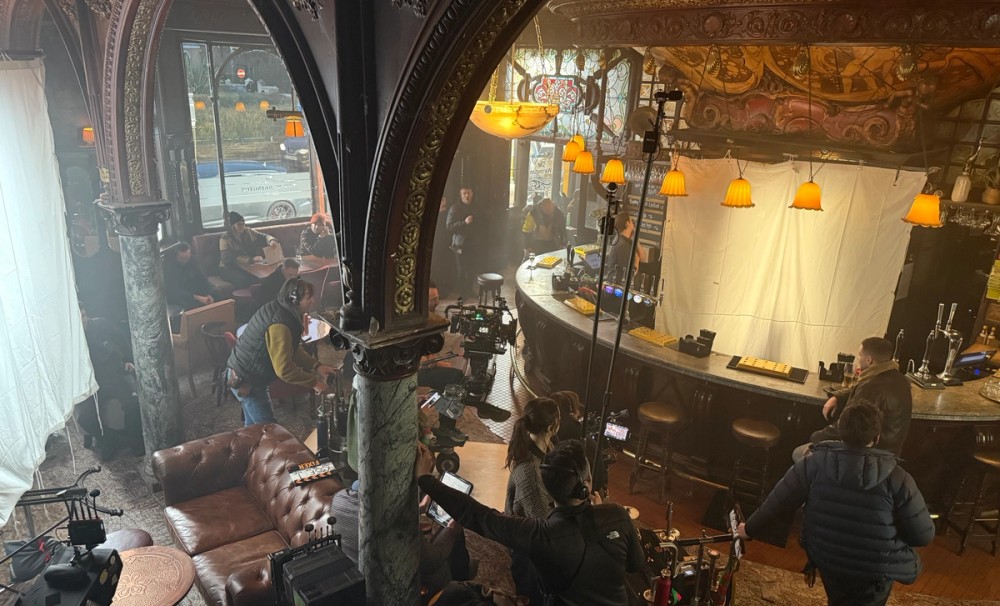
The Aputure INFINIMAT 4x4 with diffusion on set. Image courtesy of Harlon Haveland.
Speed, Softness, and Portability
One of the INFINIMAT’s biggest advantages was how quickly it could replace traditional setups.
“Instead of building a book light, we’d just put the INFINIMAT in a corner with diffusion in front of it,” Haveland explains. “Within minutes you’ve got a beautiful, soft key light. You can manoeuvre it easily, and even take it to the next set without deflating it. It’s incredibly portable.”
That portability proved essential on a production schedule Haveland describes as “unbelievably crazy.”
Mobland was shot across multiple locations in the south of England, including several in central London. In some cases, the crew couldn’t even rely on vans.
“Driving was a nightmare, so we had to take public transport between locations,” he says. “I’ve never done a job like that before. I was exhausted.”
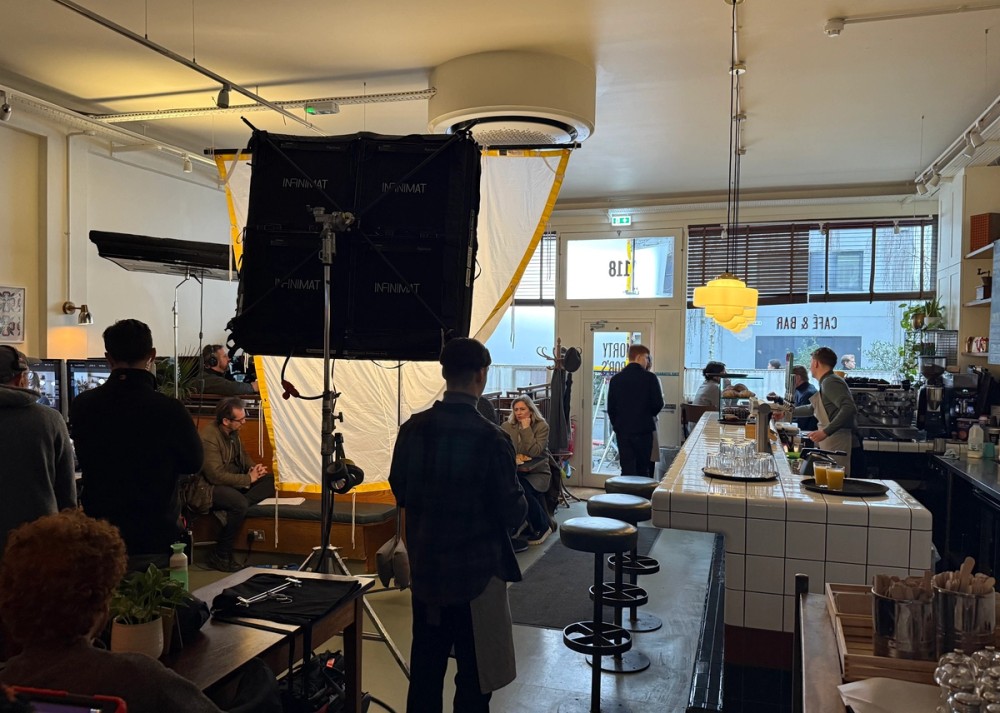
The Aputure INFINIMAT 4x4 on set. Image courtesy of Harlon Haveland.
With that level of movement, lighting setups had to be nimble, fast, and easy to deploy. Whether filming in a working pub or a café in Antwerp, the INFINIMAT was always ready.
“In one café, there was a big window. We set up two cameras, put the INFINIMAT up for a bit of directional light, and shot the scene. Once they called wrap, everything was packed up within 20 minutes.”
Ready for the Unexpected
That flexibility also paid off when plans changed at the last minute. On one occasion, Haveland got a phone call just a day before a newly scheduled night shoot in the Cotswolds—more than two hours away.
“We had to prep, drive there, rig everything, and then just hope for the best once night fell,” he recalls. “It actually turned out really good. We kind of pulled it out of the hat.”
One Tool, Many Cinematographers
Among the four cinematographers on Mobland, Stephan Pehrsson BSC was the only one already familiar with the INFINIMAT. Pehrsson also worked closely with director Guy Ritchie to define the visual foundation of the series.
“That became the base we had to build from,” Haveland explains. “The other cinematographers followed that approach.”
As David Katznelson DFF BSC, Baz Irvine BSC ISC, and Si Bell BSC joined the production, they turned to Haveland for continuity.
“They’d ask me which lights I used regularly and how. I introduced them to the INFINIMATS, and they ran with it—very enthusiastically.”
Haveland lit five episodes himself (with Oliver Whickman lighting the other five), which made him the constant presence across the series.
“They bring their own creative vision, of course,” he says. “But they’re using the same instruments. That’s how you maintain consistency.”
Designed for Tight Spaces
Many Mobland locations were small and crowded, making traditional lighting setups impractical. Here again, the INFINIMAT proved its worth.
“It takes up about 10% of the space of a standard book light,” Haveland notes. “If our lights had filled the room, the crew wouldn’t have been able to move.”
For Haveland, lighting is about more than just image quality.
“You have to be sympathetic to the entire crew. Everyone’s got a job to do, and we shouldn’t make it harder for each other.”
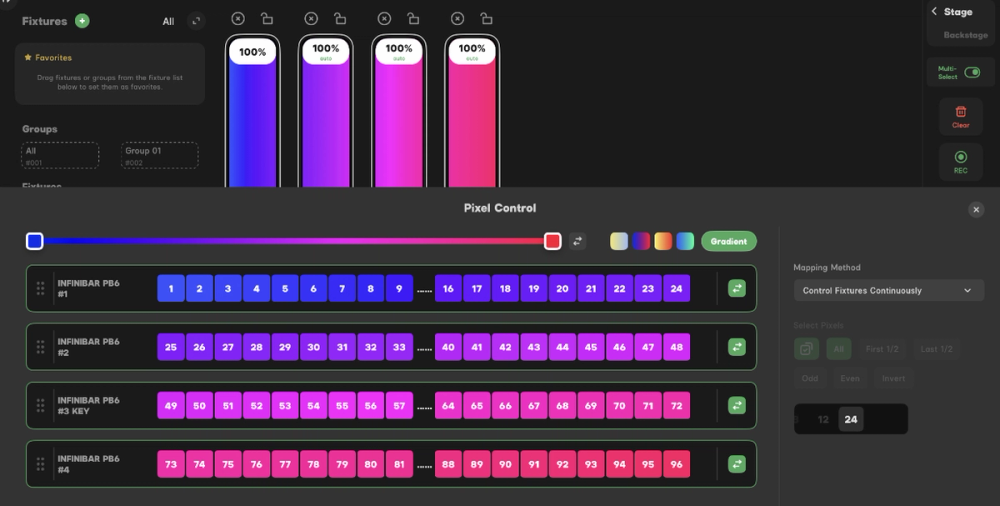
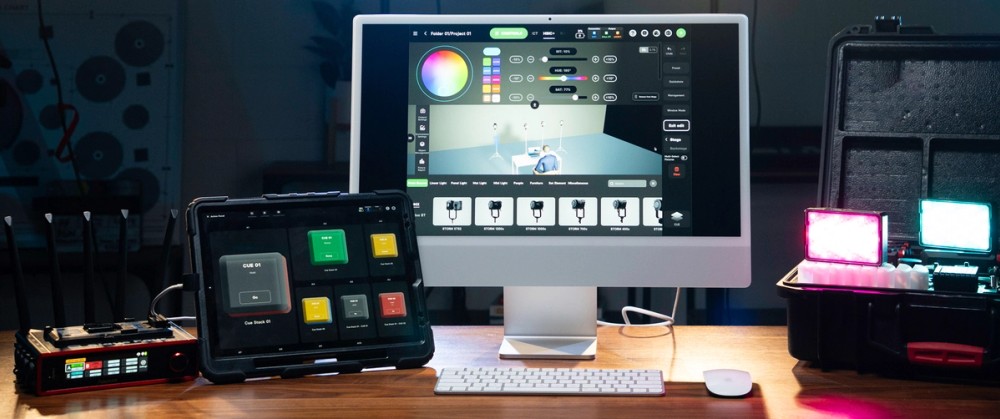
Paired with wireless control via Sidus Link Pro, the workflow became even more efficient.
“We’d set up the INFINIMATS once, and every time we switched them on, everything was already programmed. We were ready to go in minutes.”
On a fast-moving, multi-location production like Mobland, that combination of speed, consistency, and flexibility made all the difference.